All the Art and All the Thought of Greece Centered in
Greek art equally nosotros know it started around 650 BCE and lasted to effectually 27 BCE. This period of aboriginal Greek fine art is rich with cultural and socio-economical history, shaping its very essence and informing it as much as information technology informs us. It would accept a significant corporeality of time to acquire all there is to know near ancient Greek art, which predominantly constitutes of pottery, architecture, and sculpture.
Tabular array of Contents
- ane A Little Flake Near Hellas
- 2 Historical Foundations: What Are the Origins of Ancient Greece?
- 2.1 The Stone Age
- two.2 Into the Bronze Age of Greece – The Aegean Civilizations
- 3 The Greek Nighttime Ages and the Showtime of Greek Civilization
- 4 Greek Art and Architecture Characteristics
- 4.1 Archaic Period (c. 650 – 480 BCE)
- 4.two Classical Period (c. 480 – 323 BCE)
- 4.three Hellenistic Menstruation (c. 323 – 27 BCE)
- 5 To Rome and Beyond
- 6 Frequently Asked Questions
- vi.one What Were the Stages of Greek Fine art?
- half-dozen.2 What Does "Classical Order" Mean?
- 6.three What Are Some Greek Art Characteristics?
A Little Bit Nearly Hellas
Before we start with Ancient Greek fine art, let us explore the magnitude with which we are engaging, namely, Greece. When we recall of Greece, or Hellas, which is its Ancient Greek translation, we immediately know more-or-less the impact this aboriginal civilization had on shaping our Western civilisation.
Hellenic republic is a humming geographic hotspot on the world map – its location is in Southeast Europe with its capital existence Athens. The land is divided into nine regions, namely the Aegean Islands, Central Greece, Crete, Epirus, Ionian Islands, Republic of macedonia, Peloponnese, Thessaly, and Thrace. It is besides located most to where Africa, Asia, and Europe converge and borders Albania, North Macedonia, Bulgaria, and Turkey.
The seas that surround Greece include the Aegean Sea (this is towards the East of the mainland), the Ionian Sea (this is towards the West), and the Cretan and Mediterranean Seas (this is towards the Southward). There are also numerous islands surrounding Greece.
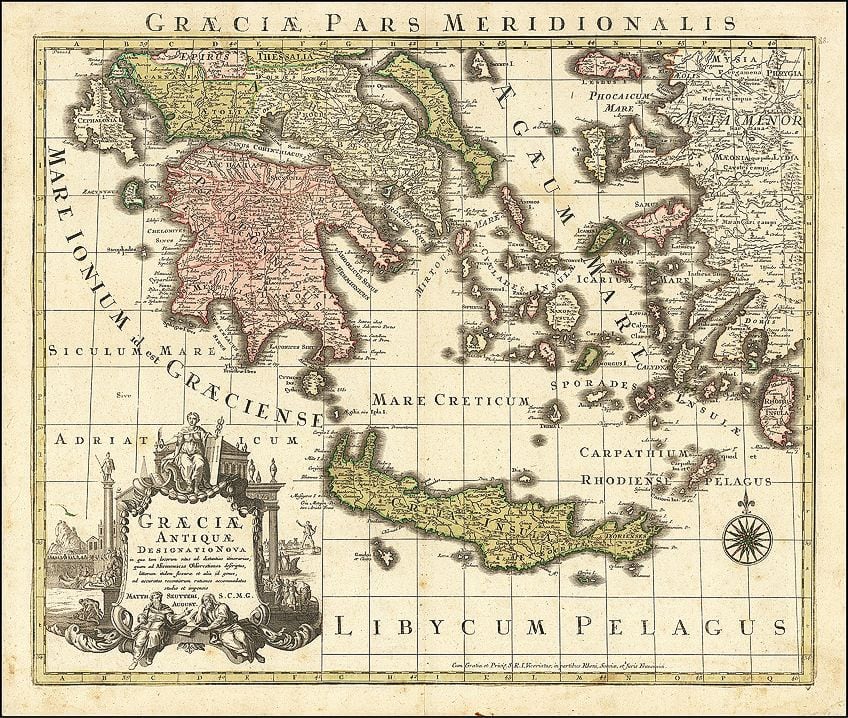 Map of Ancient Greece by Matthäus Seutter, 1740;Matthäus Seutter, Public domain, via Wikimedia Commons
We also know the famous Mount Olympus, which is Greece's highest mountain with Mytikas, its highest pinnacle, at 9,570 feet. Olympus is worth noting as it holds an important place inside Greek Mythology, existing as the identify where the gods would reside with Zeus on the throne.
Hellenic republic is also widely considered every bit the "cradle" or "birthplace" of Western civilization. It was the starting signal of various cultural and political doctrines, for instance, democracy and philosophy. It besides explored and adult various principles related to mathematics and science. In culture, information technology prepare the stage for drama, art, architecture, pottery, sculpture, and literature, and in sports, the Olympic Games, which is nevertheless ongoing in our present twenty-four hour period and historic period.
Historical Foundations: What Are the Origins of Ancient Greece?
The best way to empathize the historical foundations of ancient Greece is to look at its diverse periods throughout its evolution as a civilization, every bit in that location are numerous timeframes and stages of progression. Notably, Hellenic republic goes back all the way to prehistory with the Stone Age, which ended around 3,200 BC, and and then into the Statuary Age, which started effectually three,200 BC.
The Stone Age
The Rock Ages were divided into three distinct periods, namely, the earliest, Paleolithic, followed by the Mesolithic, and and then the concluding, the Neolithic. During the Neolithic Greek Age (7000 BC-3200BC), in that location was an increased development of farming and stockbreeding, also as new advances in architecture and various tools used.
The Neolithic Greek Age was further divided into half-dozen stages, namely, Aceramic (Pre-Pottery), Early Neolithic, Middle Neolithic, Late Neolithic I, Belatedly Neolithic II, and Final Neolithic. With every micro-menstruum within the Neolithic Age, in that location were new developments in farming and civilisation.
It is of import to empathise that these periods prepare the phase, and then to say, for Ancient Greek art.
Information technology was during the Early Neolithic menstruum when people developed techniques to fire vases. The Middle Neolithic period brought with it new developments in architecture, namely the "megaroid", as well referred to every bit the "megaron". This was a rectangular-shaped house with one sleeping accommodation and porches (open or airtight), and it would also have columns at the front entrances.
The importance of the megaron structure is that it developed into the hall for Greek palaces. It is one of the primary characteristics of Greek architecture, likewise described every bit being "rectilinear" in shape. This would as well become the shape for Greek temples.
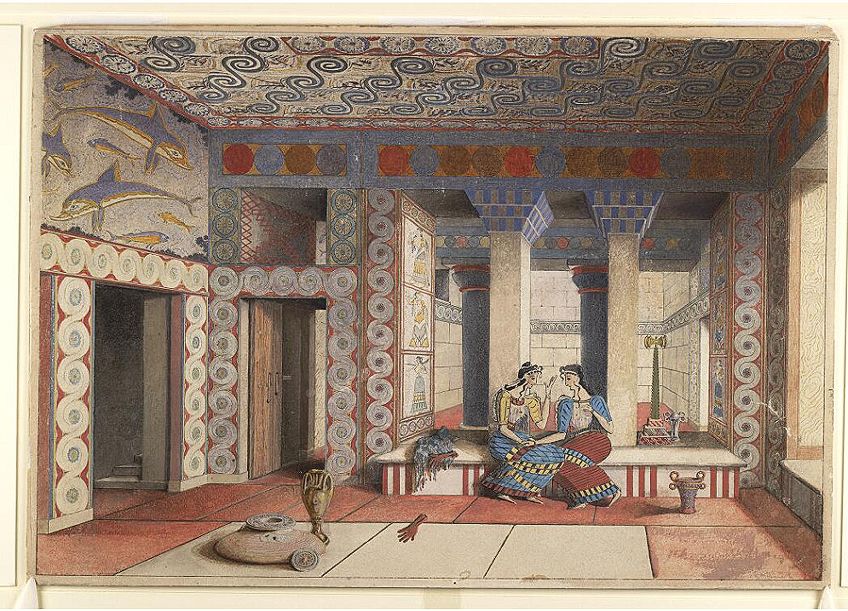 Romantic reconstruction drawing of the "Queen'due south Megaron" by Emile Gilliéron the younger. From the papers of Arthur Evans relating to excavations in Crete, between 1922 and 1926;Gilli‰ron, Ðmile fils, CC By 4.0, via Wikimedia Commons
Other architectural developments were the "Tsangli" structure, which was a settlement. This structure included two buttresses inside the house to add additional support for the roof. At that place were also rooms designated for different purposes. Houses during this period developed meliorate foundations fabricated of stone compared to the huts during the before stage. During the later Neolithic periods, in that location was an increment of advancements in farming and agronomics, and this period moved into the Statuary Age when people imported copper and bronze metals.
The Neolithic Greek Age occurred in various locations around Greece, namely, Athens, Dimini, Franchthi Cavern, Knossos, Milos, Nea Nikomedeia, and Sesklo.
Into the Bronze Age of Greece – The Aegean Civilizations
The Greek Bronze Age is categorized by three dominant locations, and is also referred to as the Aegean Civilization, which was centered around the Aegean Sea. The primary locations were, namely, the Cyclades, which are islands located southeast from the mainland of Greece, Crete, which lies more southward of the mainland of Greece, and then there is the Greek Mainland.
Each geographic area had dissimilar cultures. The Cycladic civilization (circa 3300-2000BC) from the Cyclades, the Minoan civilization (circa 2700-1100 BC), which was from Crete, and the Mycenaean culture (circa 3200-1050), which was from Mainland Greece. The development of each civilization overlapped with the other, although the Mycenaean civilization eventually captivated the Minoans.
Some of the notable features of these periods include writing, known as Linear A and Linear B, more trade, and various new tools.
The Cyclades civilization created female person figurines, or idols, fashioned out of marble. Many of these announced with large oval faces and elongated noses. The primary sites for this civilisation were Keros, Grotta, Phylakopi, and Syros.
The Minoans were largely located at Knossos, and other areas like Malia, Phaistos, and Zakros. The Minoans are known for having provided the earliest foundations for European Civilization. Their civilization was advanced in many ways, from non only writing and more extensive trade (traveling to places similar Egypt exposed them to different cultures), but their art and architecture consisted of ancient Greek paintings like frescoes, which were brightly painted of subject area thing like animals from the state and body of water, and landscapes of nature. These were ofttimes painted inside the palaces. The frescoes would also accept borders in decorative patterns.
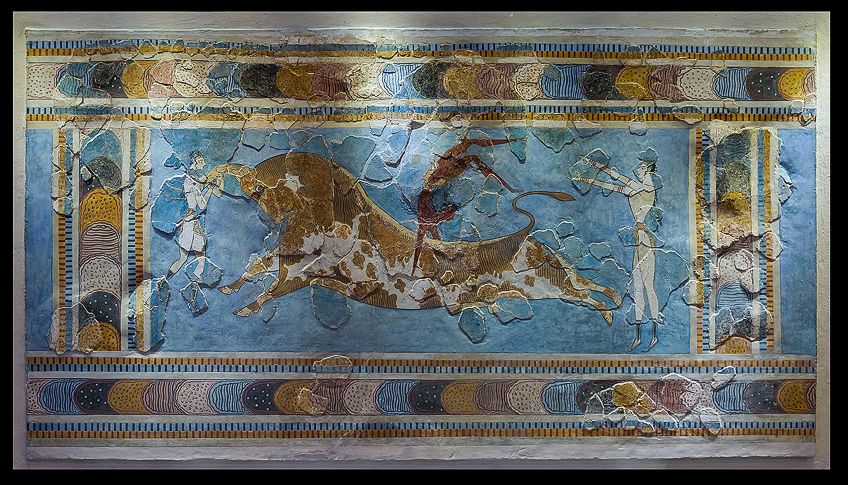 Toreador Fresco (Bull-Leaping Fresco) (c. 1600-1450 BC), found in Knossos palace, Crete, Greece. Part of a five-panel composition, the iconic Toreador Fresco depicts an acrobat at the back of a charging bull. A second effigy prepares to jump, while a third waits with artillery outstretched;Heraklion Archaeological Museum, CC0, via Wikimedia Commons
Beyond ancient Greek paintings, the Minoans also produced a wide variety of greek pottery and ceramics. Examples of the different shapes of vessels include the amphora (with 3 handles), various beakers, rounded vessels, and storage jars referred to as pithos. Ceremonial jugs were made to comprise libations for rituals, and these were known as rhytaand made in the shape of an animal's head.
The balderdash was a significant fauna in their culture, and they would oftentimes depict the bull's horns in their art and decorations. The Minoans also had gold jewelry, sculptures, and palaces built to the peak of iv stories. Palaces were meaning features in the Minoan culture, and alongside their all-encompassing layouts, diverse farming communities surrounded a cardinal palace, and roads were fabricated to connect the farms or villages.
The Mycenaean civilization was located mainly in Mycenae, and other areas like Athens, Thebes, Pylos, Sparta, among others. Information technology is also referred to as the "Helladic" menses. Since the Mycenaeans lived on Mainland Greece, they are also described as "indigenous".
Trading was common amidst this culture, namely in goods like aureate, glass, copper, and even ivory.
The Mycenaeans created artworks that were influenced by the Minoan civilization. They were known as having a strong warrior culture when compared to the Minoans. The Trojan War is a famous war and is popularized to this day through films like Troy. When nosotros look at frescoes created, the Mycenaeans besides depicted a diverseness of scenes relating to battle, animals, nature, warriors marching with their weapons, and diverse other subject matter similar to that of the Minoans.
In fact, the similarities between Mycenaean Art and Minoan Art are oftentimes noted, although Mycenaean Art is described as appearing more than "geometric" and "formal" in its style. However, at that place would have been trade between Crete (Minoans) and Mycenae, which explains the styles of fine art converging between the two cultures.
The well-known King of beasts Gate (c. 1250 BC) is one of the lasting remnants of an architectural "relief" sculpture, depicting two lions (or lionesses) facing one some other, standing on their hind legs with their front legs resting on a block-like base, with a cavalcade in the heart betwixt the two animals. The King of beasts Gate is located as the master entryway to the acropolis, which is where the palace and citadel were situated.
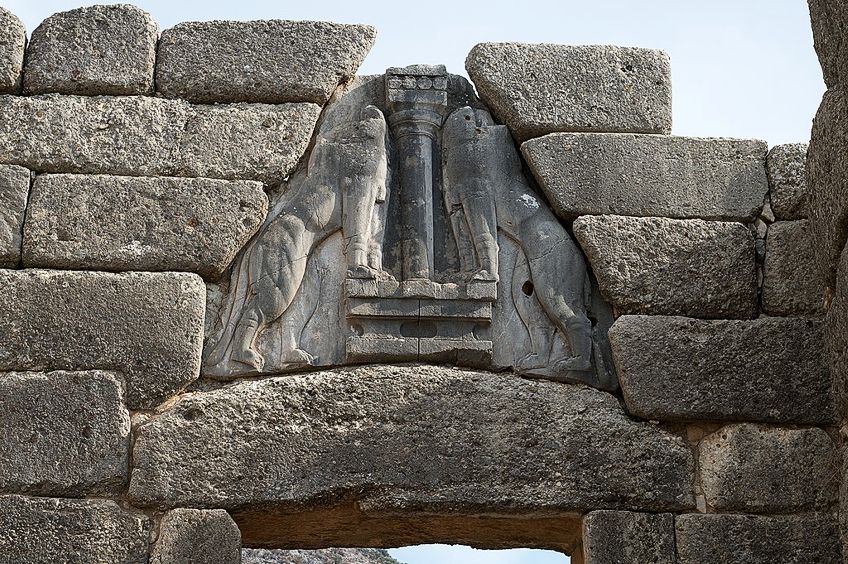 Relief of the Lion Gate(c. 1250 BC), Mycenae;Zde, CC BY-SA 4.0, via Wikimedia Commons
The Greek Dark Ages and the Start of Greek Civilization
The Mycenaean civilization concluded effectually 1100 BC. The autumn of this culture and many others around that menstruum is a widely debated topic. Many sources bespeak to invasions by the Dorian civilization, climate changes, natural disasters similar earthquakes, and other social bug like famine and overpopulation.
This flow is referred to every bit the "Late Bronze Historic period Collapse", which would eventually go what is known as the "Greek Dark Ages". This flow started around 1100 BC to around 750 BC. It was also referred to as the "Homeric" period, which related to Homer's poems the Iliad and the Odyssey.
Almost congruent with the to a higher place-mentioned periods, the Geometric menses (900-700 BC) occurred almost the stop of the Greek Dark Ages, and in the context of style, art on pottery was depicted in geometric shapes, which gave this flow its proper name. Information technology was afterwards this period that Greece started to develop and evolve.
After this, there was an increase in population and ancient Greek art really took shape, embodying the ideals of Classical Art every bit nosotros now know it.
Greek Art and Architecture Characteristics
When we look at Greek art, nosotros remember in terms of idealized marble sculptures and human figures that announced as perfect and beautiful every bit a supermodel. There were 3 distinguishing periods in Greek fine art that characterized its development. Below, nosotros look at these three periods along with diverse characteristics and notable artists within each.
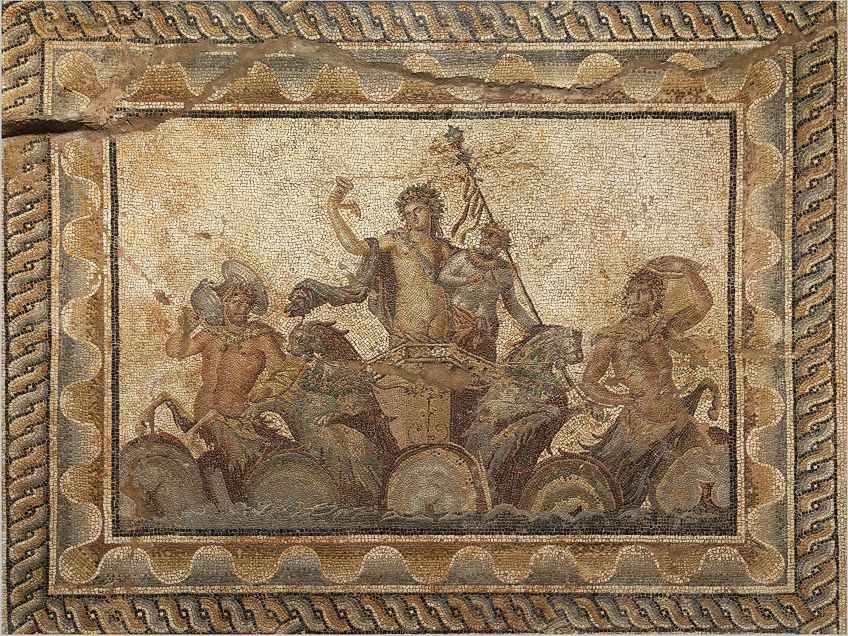 Epiphany of Dionysus mosaic, from the Villa of Dionysus (2nd century Advertisement) in Dion, Greece. At present in the Archeological Museum of Dion; Anonymous Unknown author, Public domain, via Wikimedia Commons
Archaic Period (c. 650 – 480 BCE)
The Primitive Period occurred with the onset of the Greek Olympic Games in 776 BC, which is often noted equally when this catamenia truly started. Politically and socially, this period also saw the first of the city-country, referred to as polis, which means "city" in Greek. These poleis were mainly ruled nether tyranny, although in that location is also debate that this tyrannical rule was not the aforementioned as what it became in afterwards years. Tyrants substantially assisted communities to become more than expansive in wealth and work opportunities.
Art during the Primitive Menstruation is described as more than naturalistic in its portrayal compared to the Geometric menstruation. Some of the primary forms of artwork were pottery, painting, sculpture, and architecture. Because of trade between various Eastern countries, in that location was a wide Oriental influence noticeable on vases and vessels. More animals like lions, griffins, and sphinxes were painted and artists employed decorative motifs similar curves and floral patterns.
The human being form was also depicted non only in painting on pottery but also in sculpture. This is evident in the various life-sized figure sculptures created from stone. While in that location was realism in their portrayal, there was also an idealism largely influenced by the Mycenaeans and the show of strength and physical prowess of the masculine form.
This was largely displayed in the athletes and warriors of the time, marking the Mycenaean culture equally a "Gilded Historic period" because of the bravery and heroism.
The human being grade in sculpture during the Archaic Period is seen in well-known examples referred to as kouros ("young boy") and kore ("young girl"). These statues were in a "frontal" stance, begetting influence from Egyptian statues at the time, also every bit existence "freestanding". The features that characterize them include an upright opinion with artillery at the sides, feet closely side by side to the other, and broad shoulders.
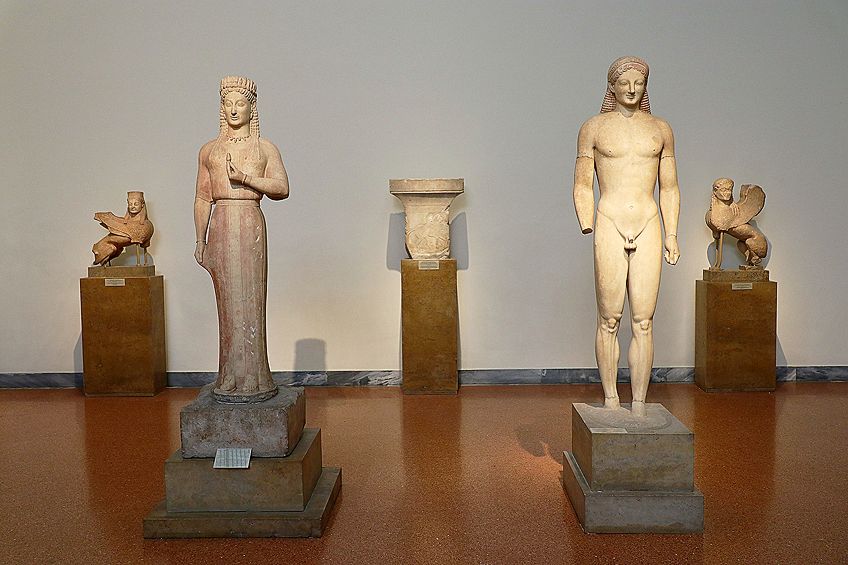 Statue of a kore (left) and a kouros (right), both made from Parian marble. Plant in Merenda (ancient Myrrhinous), Attica. Both are important works of the ripe Archaic way and its menstruation;George Eastward. Koronaios, CC BY-SA 4.0, via Wikimedia Commons
The female counterpart, the kore, was ofttimes depicted wearing dresses of their time with some stylistic elements. In both types of statues, we see what is referred to as the "archaic grinning", which gives the appearance of softness and quiet for both male person and female statues. This is a notable characteristic as information technology symbolizes idealism.
Furthermore, the purpose for these statues varied, for example, the korai were used equally votive offerings to Greek goddesses like Athena. The kouroi were used as memorials to either deceased individuals or given to winners of games played and competed in.
In that location are numerous reasons why these statues were used; some also believe they were of the god Apollo and made to resemble Greek deities.
Examples of Greek sculptors and Athenian arts during this period include the Athenian, Kritios, who worked in the later stages of the Primitive Flow. He is considered to have greatly influenced the more than realistic artistic styles in sculpture in the subsequent Classical Menstruum. He is known as being the student of the sculptor named Antenor (c.540-500 BC), who created The Tyrranicides (510 BCE).
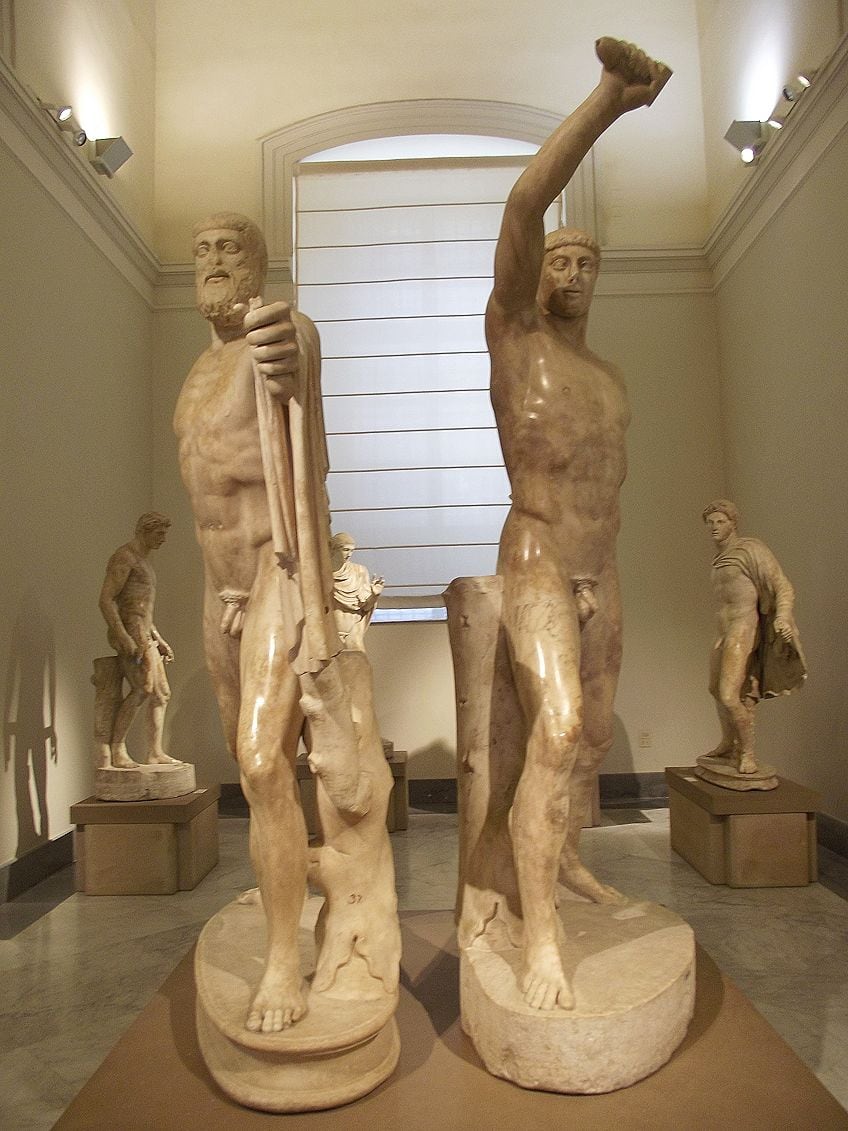 Statue of Harmodius and Aristogeiton, part of the Tyrranicides group;Elliott Brown, CC BY 2.0, via Wikimedia Commons
Tyrranicides was commissioned by Cleisthenes, a political leader who set the foundations for democracy in Athens during the half-dozenthursday Century BC. He was remembered every bit the "founder of Athenian democracy". The sculpture depicts the two figures, Harmodius and Aristogeiton, who assassinated the tyrant Hipparchus.
Kritios recreated this sculpture with another sculptor chosen Nesiotes later on information technology was taken past Xerxes I during the war between Persia and Hellenic republic. Kritios is too famous for his sculpture named Kritios Boy (c.490-480 BCE). In size, it is recorded as existence smaller than a life-sized sculpture.
As an Early Classical Catamenia piece, Kritios showed Greek sculptors a new mode in depicting the human effigy. We besides run across this technique commonly utilized in Renaissance and Neoclassical paintings and sculpture, and is referred to as "contrapposto" – the Kritios Boy is standing with his weight on i leg, giving the body a slight "S-Curve".
Kritios sculpted all the anatomical accuracies inherent in a posture like this one. We see how the left hip is elevated and the buttocks on the correct is not tensed. Other features of this work show the dropped left shoulder, the rib cage appearing as if the figure is inhaling due to its expansion, and the facial expression, which is not as arcadian as we see in previous Early Archaic sculptures.
Kritios is described as producing work that is more than "astringent" in style. This is exemplified in the figure'due south mouth; it is not the "primitive grinning" we and so oftentimes come across from the idealized expressions of earlier, merely appears more than serious in expression.
This piece of work is at present housed and displayed in the Acropolis Museum in Athens with many other Athenian arts. The statue was one of many other ancient Greek artifacts plant in the "Farsi Rubble", called Perserschutt, left behind by the Persian invaders after they sacked the Acropolis during 480 BC.
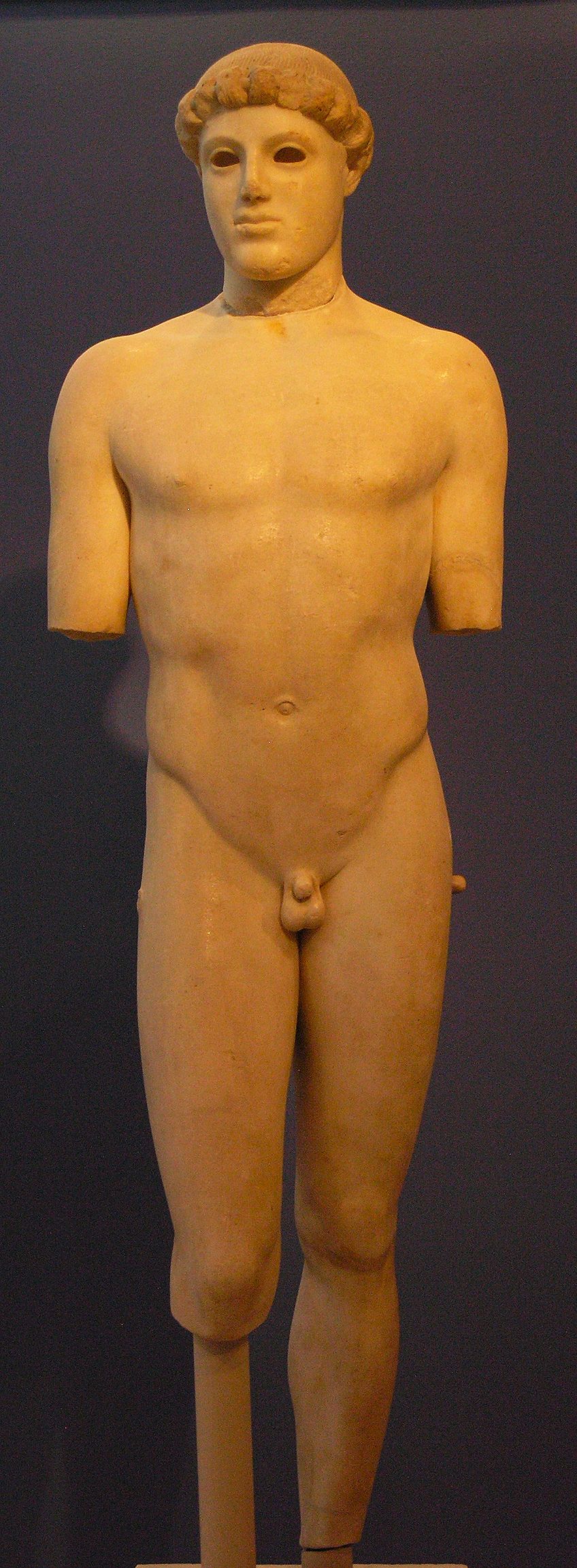 Kritios Boy (c. 480 BC) by Kritios; Critius, CC BY-SA 2.5, via Wikimedia Commons
Classical Period (c. 480 – 323 BCE)
Where the Archaic Period is often described as being experimental in its portrayal of realism in the homo class, the Classical period was a considerable advancement frontwards, depicting a naturalism in the homo course. This flow in Greece was too considered the "Gold Age" considering of the Greeks' victory over Persia, which is known as the Greco-Persian War.
This new period of peace and victory gave birth to many new developments in non merely arts and architecture, but philosophy (with some of the greatest philosophers of Western history, namely, Socrates, Plato, and Aristotle), scientific discipline, and politics. The city-state of Athens was too rebuilt after the war.
The "Aureate Age" lasted for around 50 years until the Peloponnesian War in 431 BCE, where Sparta won power over Athens. However, the Macedonian state of war and then took over the Greek states, nether the rule of King Philip 2 so his son, Alexander the Bully.
The philosophies of Plato and Aristotle had a profound effect on Greek artwork and how Greek artists depicted the homo figure. Plato also started an university in Athens (c.387). This ushered in new ways of thinking, making reason and knowledge an important determining cistron that underpinned many beliefs and perspectives.
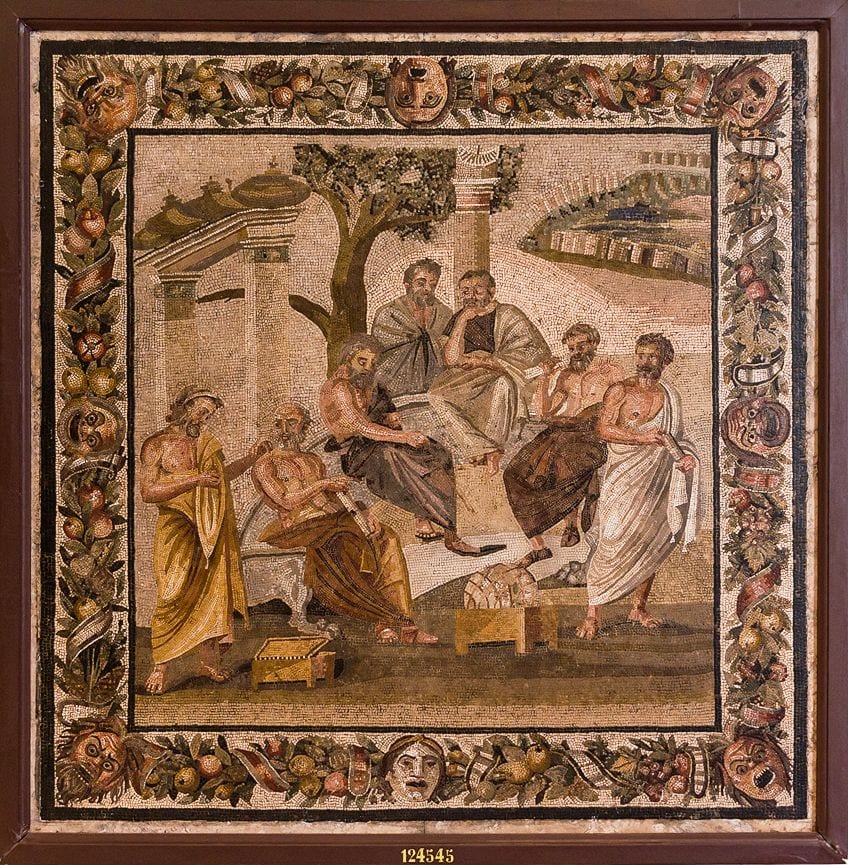 Plato's University mosaic (from Pompeii, c. offset century), now at the Museo Nazionale Archeologico, Naples; Naples National Archaeological Museum, Public domain, via Wikimedia Commons
Classical Greek Sculpture
Art became a representation of the natural. In other words, it became true to nature and true to real-life proportions. Greek artists began to create sculptures that appeared human-like and detailed, but however cute and perfected. This brings us to what was known as the "Canon of Proportions".
This term refers to the perfect artwork, or and then according to Greek sculptor Polykleitos. He developed what was termed "The Catechism" (circa 450 BCE), a set of ratios based on mathematical measurements of the human body to depict each trunk part in perfect guild and symmetry – in other words, perfect proportion.
An example of this is in his sculpture Doryphoros ('Spear Bearer', c. 440 BCE), which depicts a nude male warrior. This piece of work has been reproduced in marble by other sculptors due to the original bronze sculpture being lost. Even so, the replicas bespeak the ideal perfection of the male course obtained through mathematical measurements.
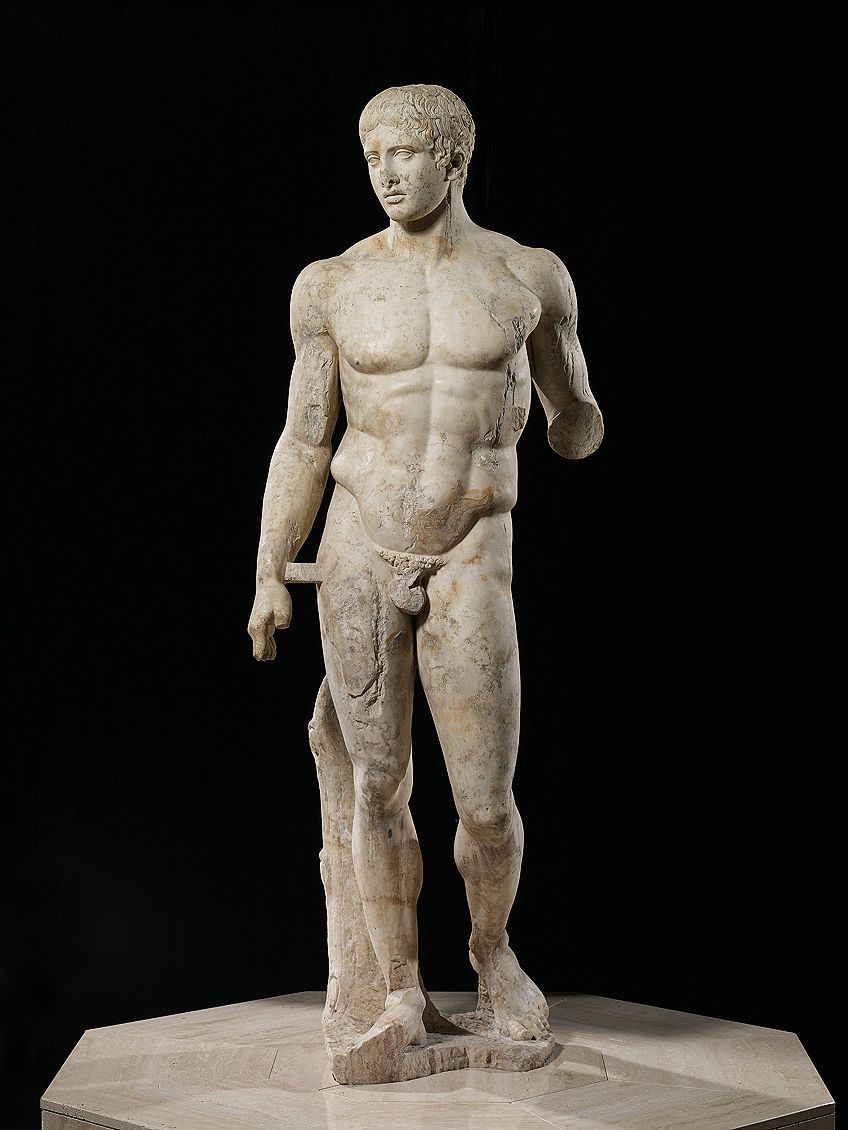 Doryphoros ('Spear Bearer', c. 440 BCE) by Polykleitos;Minneapolis Institute of Art, Public domain, via Wikimedia Commons
This sculpture was as well a physical example of Polykleitos' theoretical underpinnings nigh achieving perfect form through proportions, which ultimately sought to illustrate harmony and perfect residual. The word "Canon" means "rule" or "measure".
It was the interest in achieving and depicting the arcadian human effigy, which was usually sought in the figures of male athletes and warriors, that became widespread in Greek sculpture. We also come across this in many other well-known Greek sculptors of the Classical period, such as Myron'south classic Discobolus ('Discus Thrower', c. 425 BCE).
The Discobolus was originally in bronze merely recreated by various Roman sculptors over time in bronze and marble. It is a male discus thrower portrayed fully in the act of throwing the discus. His body appears contorted to prepare for the throw, putting him in the classical contrapposto stance. We come across his correct arm backside him holding the discus, and his head is turned in that direction – any moment we wait the arm to swing forrard. This image creates a sense of naturalism in the man figure and displays each body function in correlation with the other.
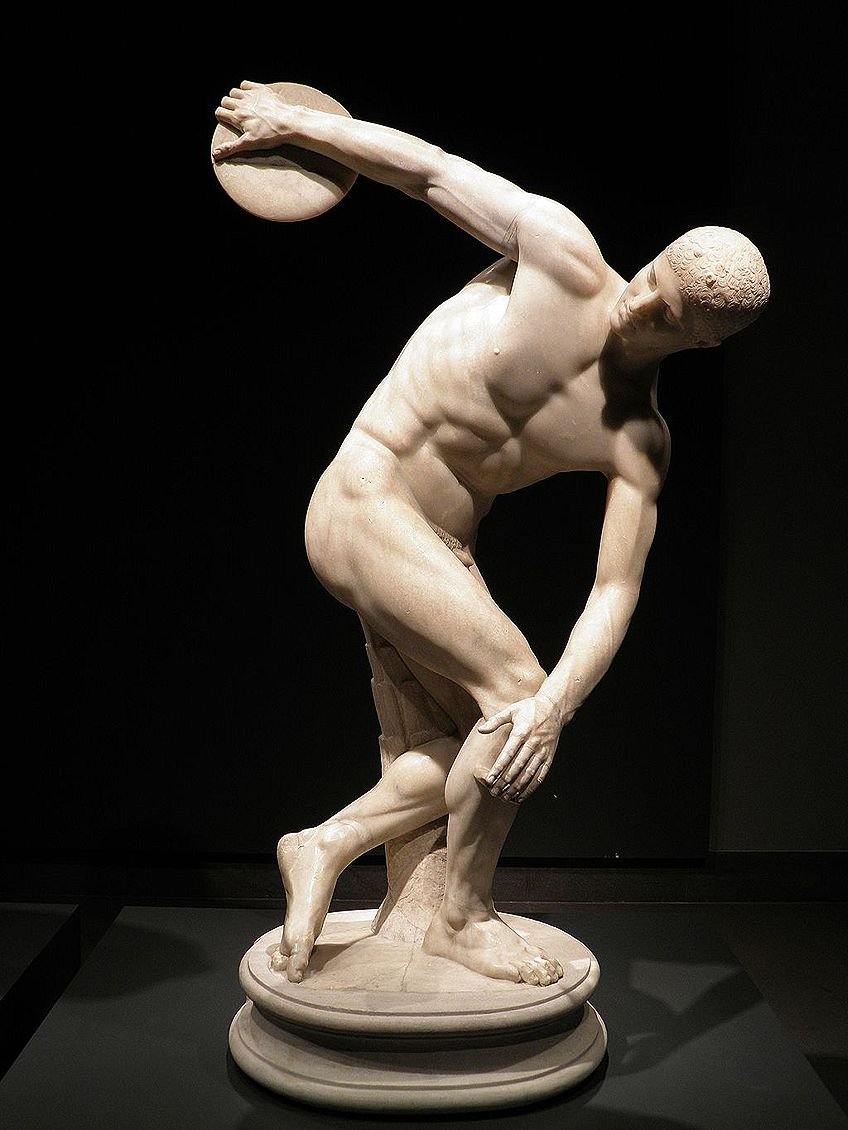 The Discobolus Lancellotti, Roman re-create of a 5th century BC Greek original by Myron, Hadrianic menstruation, Palazzo Massimo alle Terme;Carole Raddato from FRANKFURT, Germany, CC Past-SA ii.0, via Wikimedia Commons
Praxiteles was another prominent sculptor of the 4th Century BC, famous for his life-sized female nude sculptures, of which he was a pioneer. I of his popular sculptures includesAphrodite of Cnidus (c. 4th Century BC), depicting the nude female holding a bath towel in her left hand (or reaching for one) while covering her genitalia with her right manus, with her breasts uncovered.
A sculpture such as this was revolutionary at the time because all sculptures were typically done of male person nudes. Additionally, sculpting the Greek goddess as life-sized created farther impact, and it was clear that Praxiteles had set the tone for Greek sculpture in a daring new style. His Aphrodite was also described by the famous Roman writer, Pliny the Elder, as 1 of the finest sculptures fabricated.
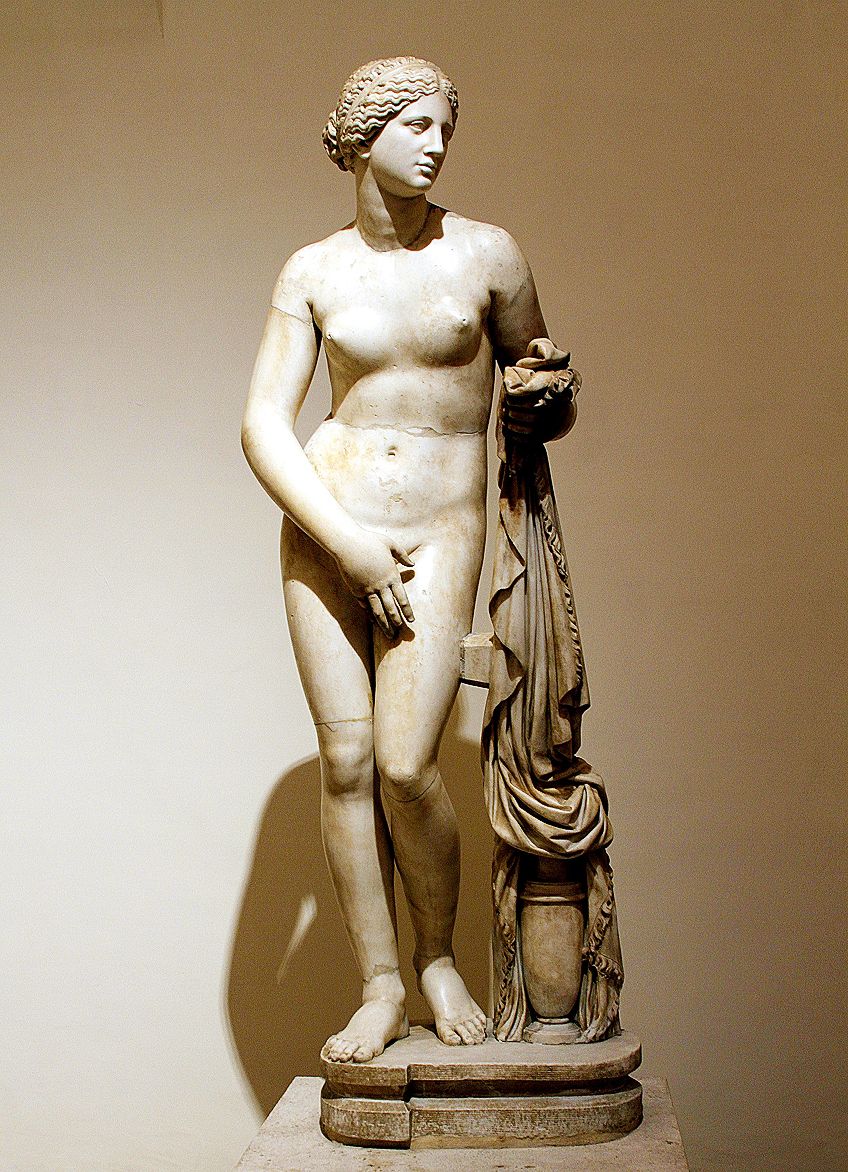 Aphrodite of Knidos (c. 4th century BC) past Praxiteles;José Luiz Bernardes Ribeiro, CC BY four.0, via Wikimedia Commons
Classical Greek Architecture
The grandeur of Classical Greek compages is illustrated past the famous Greek temple, the Parthenon (447-432 BCE). Information technology is a large rectangular structure located on the Acropolis of Athens, which is a apartment loma overlooking the city. It was designed by architects Ictinus and Callicrates in dedication to the Greek goddess Athena.
A awe-inspiring sculpture was housed in the center of the temple, titled Athena Parthenos. Information technology was created by a well-known Greek sculptor, Phidias. The sculpture was an example of the majesty of Athena and was around xl feet in acme and made of ivory and aureate (the goddess' skin was sculpted in ivory and her clothes were made from gilded textile).
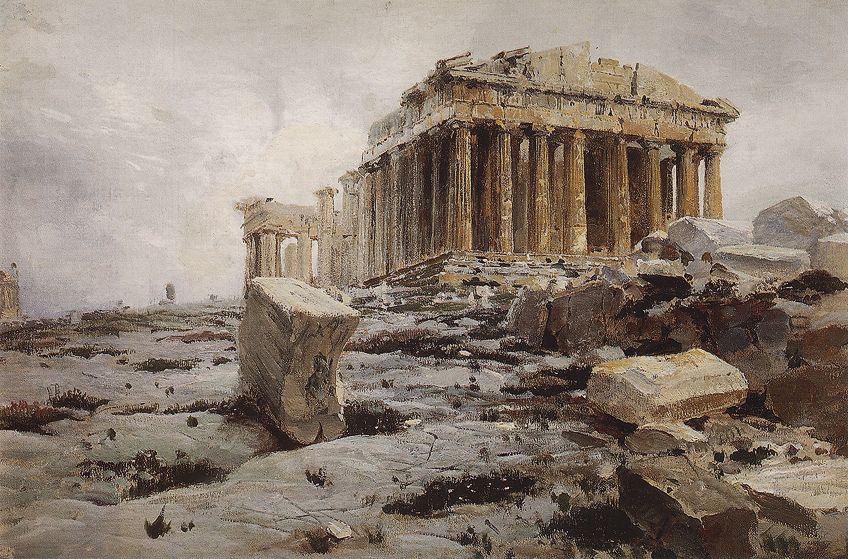 Parthenon by Vasiliy Polenov (1881-1882);Vasily Polenov, Public domain, via Wikimedia Commons
The Parthenon had multitudes of other sculptures and friezes surrounding it, including 17 Doric Order columns along the longer horizontal sides and eight along the shorter sides. The Doric Gild columns are a attestation to another architectural development within this menses, namely the Doric and Ionic column styles. The latter, Ionic way, was besides prominent in the subsequent Hellenistic flow, from which the tertiary, Corinthian style, besides emerged.
Equally the beginning development of the architectural "Orders", the Doric fashion is plainer and described as "austere". It consists of the top of the cavalcade, known equally the "upper-case letter", which is non decorated simply plain stone. The base rests without back up on the stylobate, which is the upper pace on a temple'due south crepidoma (the leveled or tiered foundation that holds the superstructure). The difference between the Ionic style is that the majuscule is more than stylized and busy, often described equally being more slender in appearance than the robust Doric style. The Ionic column also includes a base of operations to support it.
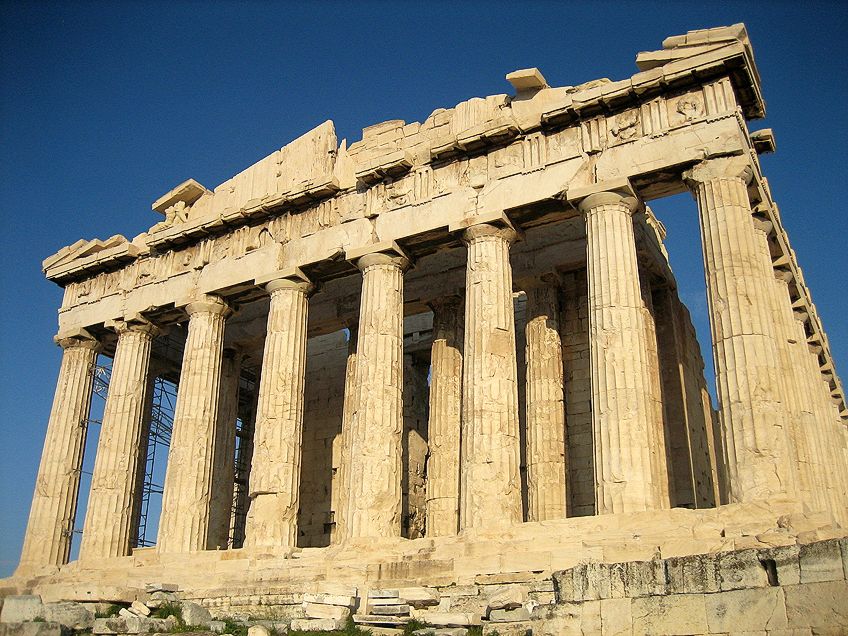 A photo of the Parthenon from the west;User:Mountain, Public domain, via Wikimedia Commons
Hellenistic Period (c. 323 – 27 BCE)
While the Classical Period is marked past being under the dominion of Philip Two of Macedonia, virtually the end of this menstruation, King Philip II was assassinated and replaced past his son, Alexander the Groovy. The Hellenistic Period, or Hellenism, came into result later Alexander's death in 323 BCE. However, since Alexander did not accept a successor, at that place was a period of uncertainty betwixt all the generals.
This uncertainty led Alexander's generals to define their power in different dynasties, however, the Roman Republic somewhen took over Macedonia in 146 BC, and in 27 BCE, Emperor Augustus took over Greece and it became function of the Roman Empire.
The Romans were greatly inspired by Greek art and architecture, and we will notice numerous replicas in marble done from Greek-inspired art.
During the Hellenistic Catamenia, Greek art became more various with a wider range of field of study matter, including not merely young or warrior-like males but everyday folk, including animals. Greek artists likewise moved away from depicting the ideal, as there was a heightened naturalism – most to the bespeak of existence dramatic – in sculpture and painting. Art was also deputed by patrons and created as decorative additions to homes, such as bronze statues.
Hellenistic Greek Sculpture
Greek sculptures appeared more emotive in expression during this menses. Because the rigidity and idealism of the "archaic smile" from the preceding periods, in that location has been considerable evolution in depicting the human form and going beyond its physicality. There is a focus on drama and emotion with this catamenia often described equally being more than pro-theatrical in art and architecture.
Many famous sculptures were created during this menstruum, such asColossus of Rhodes (c. 220 BCE) past Chares of Lindos, which was around 110 anxiety in summit. This magnificent statue was a male effigy often described as being a dedication to Helios, the sun god. Unfortunately, this statue was destroyed during an earthquake.
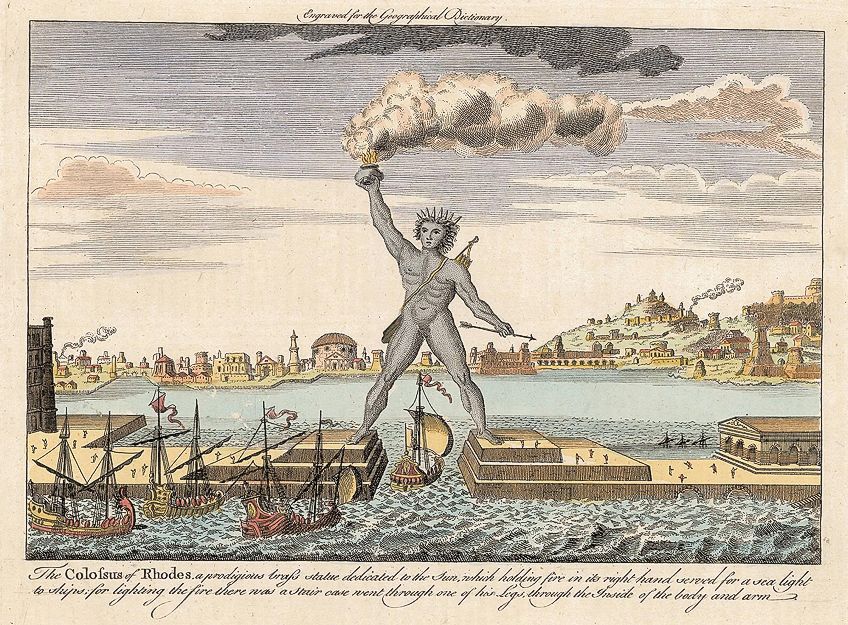 Colossus of Rhodes (c. 220 BC); Unknown author Unknown author, Public domain, via Wikimedia Commons
Some other sculpture isThe Dying Gaul (c. 230-220 BCE) by Epigonus. This depicts a typical example of the expressive nature of Hellenistic sculptures. The figure is of a Gaul, as is evident from his haircut and the ring around his neck, otherwise referred to as a "torque". He is in the process of dying, which is shown in his posture equally well as the broken sword lying next to him. What makes this sculpture so unique is that information technology captures a moment of death, inevitably evoking emotions in the viewer, which is what would accept occurred for and so many Greeks viewing this piece.
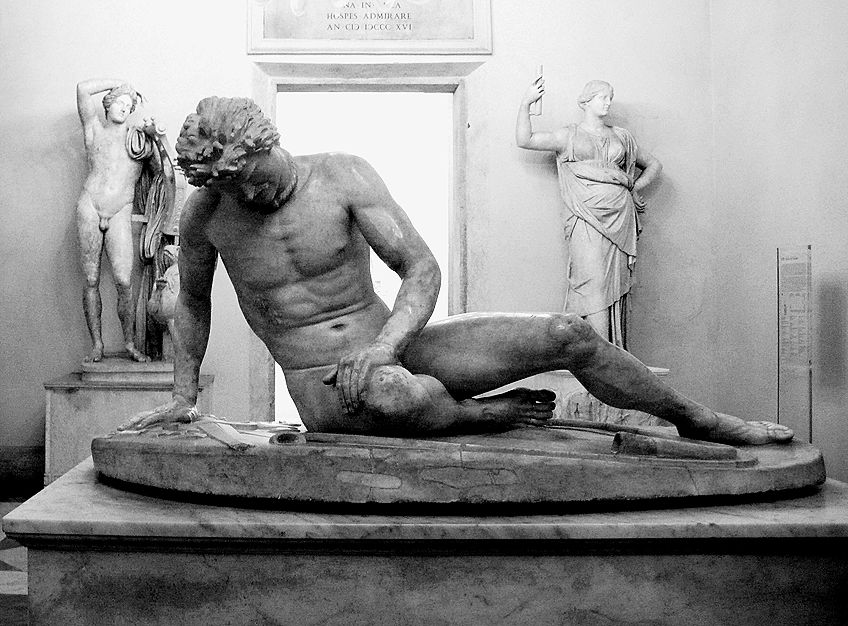 The Dying Gaul (c. 230-220 BC) by Epigonus;Capitoline Museums, CC Past 2.0, via Wikimedia Commons
Other notable sculptures include the famous Venus de Milo (130-100 BCE) by Alexandros of Antioch. Here, nosotros run into a female person figure (missing both arms), supposedly Venus, the Greek goddess of love. However, various scholarly debates propose it could either be a prostitute or the sea goddess, Amphitrite, because the statue was establish on the volcanic island of Milos (located in the Aegean Sea) in 1820.
We volition observe the familiar contrapposto ("Due south-Curve") posture in this sculpture, which is made axiomatic by the draping of her robe around her lower torso and her left leg being slightly elevated. There is also a hint of sensuality with her exposed upper torso and the robe that is just near to slide off her legs. There appears to exist a dramatic element to how she is posed, agai evoking attention from onlookers.
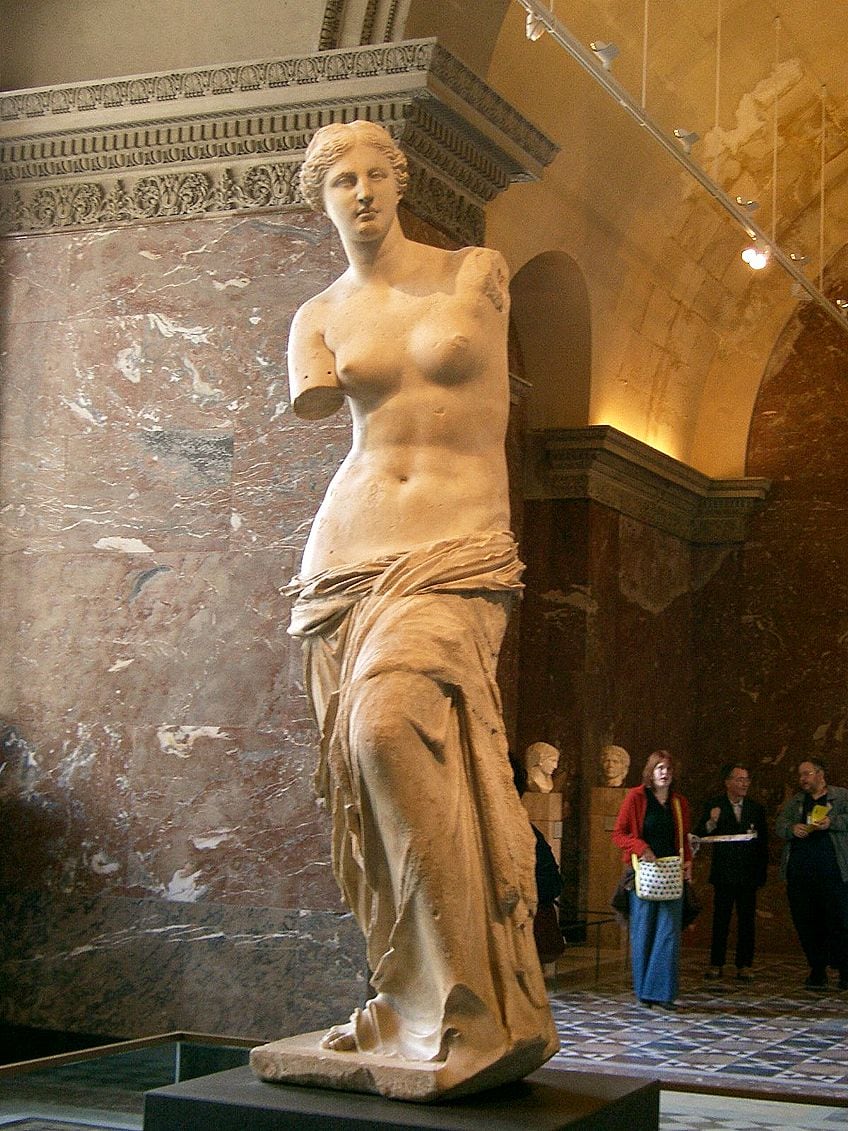 Venus de Milo (130-100 BCE) by Alexandros of Antioch, in the Musée de Louvre;Edwin Lee, CC BY 2.0, via Wikimedia Commons
We volition as well detect this heightened sense of dramatism in one of the about famous sculptures today from the Hellenistic Period, Laoco ö n and His Sons (27 BCE-68 CE) by several sculptors from Rhodes, namely, Agesandro, Athendoros, and Polydoros. This piece was excavated in 1506 in a vineyard in Rome with Michelangelo supervising the process.
In fact, afterwards its excavation, it was taken to the Vatican and put on display in the Belvedere Court Garden. This sculpture has been the model for many artists during the Renaissance catamenia and inspired many other modern artists hundreds of years later.
It is described as i of the most studied and replicated pieces of Greek art.
The subject area thing is of Laocoön, in the center, with his two sons, Antiphantes and Thymbraeus in a desperate struggle to get the biting sea serpents off them, seemingly to no avail. We notice how Laocoön himself is being bitten by one of the serpents and his son to the left has fallen over, peradventure already killed.
This sculpture catches the moment of death and struggle of the three figures, increasing the intensity of emotion and dramatic issue – added to this is the larger-than-life size of Laocoön's body. The story comes from the Trojan War, where Laocoön (who was a priest) is said to take given a alert to the Trojans most the wooden equus caballus and their plans. He was attacked by serpents as a result, in an endeavor to keep him quiet.
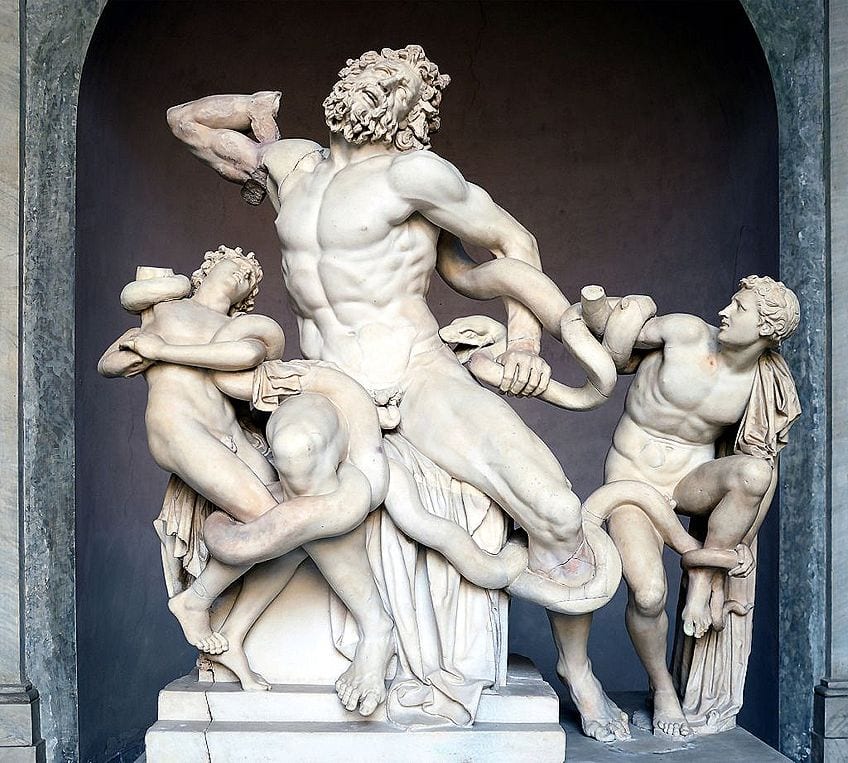 Laocoön and his sons , also known as the Laocoön Group . Marble copy after a Hellenistic original from ca. 200 BC. Plant in the Baths of Trajan, 1506;Vatican Museums, CC BY-SA 4.0, via Wikimedia Commons
Hellenistic Greek Architecture
In Hellenistic Architecture, the Corinthian Order became widely used on buildings. This was a more elaborate mode that added a decorative effect to buildings. Furthermore, architecture took on the function to accommodate more people for entertainment purposes. An example of this new development includes the Pergamon Acropolis.
Designed equally a cultural hub, so to say, this acropolis had theaters (such as the Pergamon Theater, with a capacity for 10 thousand attendees), baths, libraries, gymnasiums, and religious buildings similar temples. It truly became a testament to a new, urbanized fashion of life.
Another architectural element of this acropolis includes the Altar of Zeus (Pergamon Altar), which is over xxx meters in width. It is in the shape of an upside-downward "U", with steps comprising most of its width in the middle. Throughout the superstructure are numerous columns in the Ionic Club way. Along the base of the superstructure is the Gigantomachy frieze, which depicts the mythological story most the battle between the Greek Olympian gods and the Giants.
 Altar of Zeus in the Pergamon Museum, Berlin;Lestat (Jan Mehlich), CC BY-SA 3.0, via Wikimedia Commons
The frieze measure over 100 meters in length and is sculpted in the high-relief method. The sculpted scenes are dynamic in their portrayal and movement along each of the chantry's sides. Some figures also appear to continue onto the staircase from the frieze, every bit nosotros come across in their legs and feet, seemingly becoming a part of the whole structure instead of existence relegated to remain along the construction's sides.
Pergamon was a city ruled past the Attalid dynasty, and the creation of the Pergamon Acropolis was to establish the Kingdom of Pergamon as part of Greece after Alexander the Smashing'southward demise. The Pergamon Dynasty developed at a afterwards stage than other dynasties during this fourth dimension, and this cultural hub is a testament to their part in the Greek inheritances.
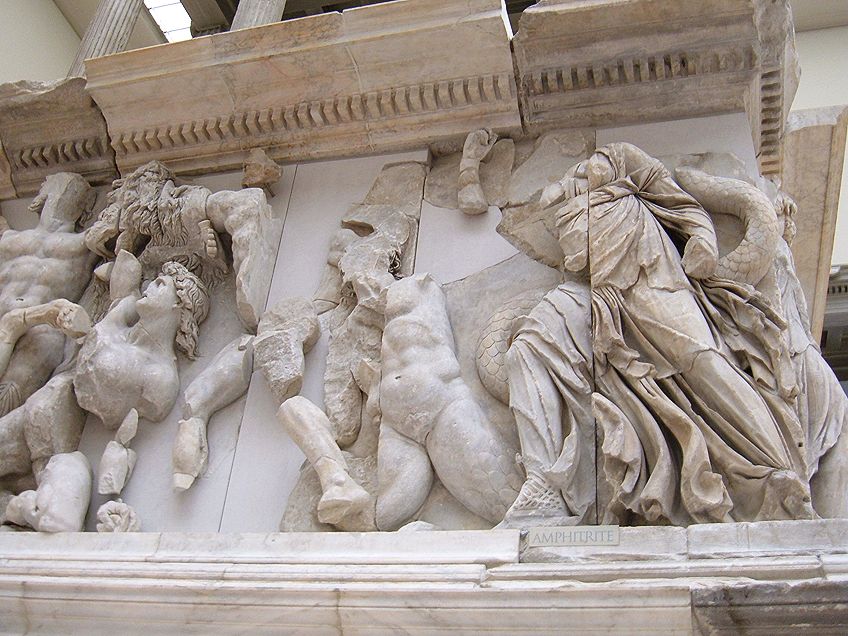 A department of the Gigantomachy frieze of the Pergamon Altar at the Pergamon Museum in Berlin, Frg;BrokenSphere, CC By-SA 3.0, via Wikimedia Commons
To Rome and Beyond
While there are many other structures and sculptures from the Hellenistic Period, this menses somewhen evolved into the dominion of the Roman Empire. The Pergamon Kingdom, nether the rule of King Attalus III, was taken over by the Roman Republic after the King's expiry in 133 BCE.
It is said the Roman Commonwealth started effectually 509 BCE, when the final male monarch (of which there were seven), Lucius Tarquinius Superbus, was overthrown by his nephew Lucius Junius Brutus, who is known as one of the first founders of the Roman Republic. After the establishment of the Roman Republic, it somewhen developed into an empire in around 27 BC, with Gaius Julius Caesar Octavianus (Augustus) as the first Emperor.
Greek artwork was greatly admired and copied past the Romans, and its classical essence of rationality, beauty, and proportion lived on through their art and architecture. Across Rome, the Greek art fashion was given a second breath, so to say, through the eyes and easily of Renaissance painters and sculptors.
Fifty-fifty to this day, nosotros are even so touched by the beauty and symmetry left behind in ratios and rations of aboriginal Greek artifacts. While most of the Greek art has since been lost or destroyed, it is remembered and immortalized by those who remembered them long ago. Thus, Ancient Greek art has get virtually like a mirror of a mirror onto the past.
Take a look at our Ancient Greece art webstory here!
Oftentimes Asked Questions
What Were the Stages of Greek Art?
Greek art has a long history, dating dorsum to pre-historic times. Nevertheless, the Classical Greek Era is divided into iii primary stages of development, namely, the Archaic Flow (c. 650-480 BCE), the Classical Period (c. 480-323 BCE), and the Hellenistic Menses (c. 323-27 BCE).
What Does "Classical Order" Hateful?
The Classical Gild is used to describe the type of column style in Greek architecture. At that place were 3 ascendant orders, namely, Doric, Ionic, and Corinthian. The Doric Order way was elementary in its fashion while the Ionic and Corinthian Orders became more than decorative, elaborate in design, and slender in appearance than the shorter Doric Lodge.
What Are Some Greek Art Characteristics?
Greek art was characterized by its delineation of dazzler in an idealized manner. Figures in sculpture especially became more naturalistic in their portrayal related to proportion and balance. The famous contrapposto technique became widely incorporated, adding a new element of dynamism to the figure portrayed. Greek fine art depicted the belief in mathematical congruency with beauty.
Source: https://artincontext.org/greek-art/
0 Response to "All the Art and All the Thought of Greece Centered in"
Post a Comment