who was Agamemnon? What does he have to do with Odysseus?
Agamemnon was the king of Mycenae and leader of the Greek army in the Trojan State of war of Homer's Illiad. He is presented as a smashing warrior merely selfish ruler, famously upsetting his invincible champion Achilles and so prolonging the state of war and suffering of his men. A hero from Greek mythology, there are no historical records of a Mycenaean king of that proper noun, but the city was a prosperous one in the Bronze Historic period, and there perhaps was a existent, albeit much shorter, Greek-led attack on Troy. Both these propositions are supported by archaeological show. Unfortunately, though, the famous golden mask plant in a shaft grave at Mycenae and widely known as the 'Mask of Agamemnon' is dated as up to 400 years before any possible Agamemnon candidate that fits a chronology of the Trojan State of war.
Family
Agamemnon was the son of Atreus, or maybe grandson, in which case his male parent was Pleisthenes. His mother was Aerope, from Crete which provided a handy link between the Mycenaean culture of the Greek Peloponnese and the earlier Minoan civilization of Statuary Age Crete. He was married to Clytemnestra with whom he had three daughters. In 1 version these are Chrysothemis, Laodice and Iphianassa while in other, later on versions they are Chrysothemis, Electra and Iphigeneia. Agamemnon was the blood brother of Menelaos, king of Sparta.
Co-ordinate to Plato, Agamemnon'southward name derives from 'menein' meaning 'to suffer'.
Mycenae
According to Homer, Agamemnon was given his rex's sceptre and right to rule Mycenae and all the Achaean Greeks past Zeus himself. Agamemnon is described equally a great warrior and then is a worthy leader of men. According to Plato, his name derives from menein meaning 'to endure'. Mycenae, located 15 km from the sea in the northern Peloponnese, so prospered and Homer describes the city as a 'well-founded citadel', equally 'wide-wayed' and as 'gold Mycenae'. This mythological prosperity is supported by the earthworks of over 15 kilograms of gold objects recovered from the shaft graves in the fortified acropolis which however dominates the plain today. Further excavations have also revealed that the urban center once covered 30,000 foursquare metres and was first inhabited in Neolithic times.
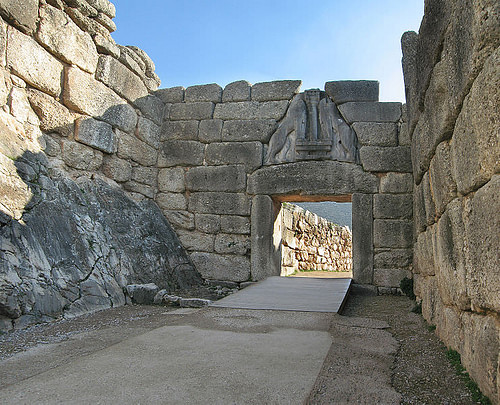
Lion'due south Gate at Mycenae
The Trojan War – The First
Our main source of information on the Trojan War is Homer's ballsy mythological account in the Iliad, written in the eighth century BCE just almost certainly based on a much older oral tradition. The ancient Greeks themselves considered the conflict to have been a existent 1 and taken place in the 13th century BCE. The story came to stand for the struggle of Greeks against foreign powers, and it told tales of a fourth dimension when men were ameliorate, more able, and more honourable. After Homer, the Trojan War became a staple theme in Classical Greek and Roman literature and was revisited many times by writers in works such as Aeschylus' Agamemnon, Euripides' Trojan Women, and Virgil'south Aeneid. Afterwards authors, particularly Aeschylus, altered parts of the story, probably for dramatic effect on an audition all besides familiar with it. Scenes from the conflict were as well a favourite with visual artists for the next millennium.
The war began when Paris, a Trojan prince, abducted Helen, married woman of Menelaus, from Sparta. Paris regarded her as his rightful reward for choosing Aphrodite as the near beautiful goddess in a competition with Athena and Hera at the wedding of Peleus and Thetis. A furious Menelaus then appealed to his brother Agamemnon to create a coalition force of Greek warriors and rescue Helen from Troy. This Agamemnon did, and the force from such cities as Athens, Sparta, Corinth, Rhodes and just virtually everywhere else across Greece sailed in a huge fleet beyond the 'wine-dark sea' to Anatolia.
Well, they would have done if Agamemnon had not upset the goddess Artemis when he killed one of her sacred stags and and so boasted he was a meliorate hunter than the goddess, herself famous for her hunting skills. As punishment, Artemis becalmed the Greek fleet and but the cede of Iphigeneia would appease the goddess into granting a fair air current to Troy. Agamemnon duly offered his girl in sacrifice, only in compassion and at the last moment, the goddess substituted a deer for the girl and made Iphigeneia a priestess at her sanctuary at Tauris. In Aeschylus' version, Agamemnon ruthlessly sacrifices his daughter, and so notwithstanding a child, and so guarantees his wife's eternal hatred and his ain murder later on in the story.
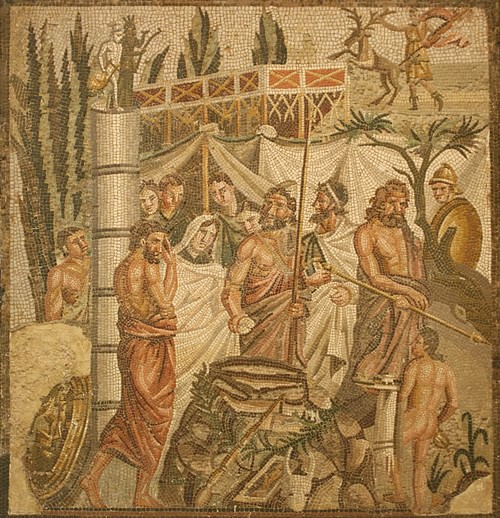
Myth of Iphigenia Mosaic, Empuries
Agamemnon Upsets Achilles
Finally arriving at Troy, almost of the next nine years was spent in the Greeks laying siege to the well-fortified city. Indecisive skirmishes ensued merely, as the Iliad tells, the fourth dimension was most for the decisive moments of the war. As Agamemnon roused his men thus,
Permit every man of yous ready well for the fighting – put a skilful border on your spears, and a good hang to your shields, requite a skillful feed to your swift-footed horses, and cast a good center over your chariots, so that we tin run the trial of hateful Ares all day long. (Iliad, Book 2, 380-384)
However, after another inconclusive clash things finally got more interesting with a couple of one-on-ane battles, first between Menelaus and Paris, and then Ajax against Paris' blood brother Hector. Neither dual ended in a fatality. More than skirmishes followed and in these Agamemnon excelled:
Every bit when annihilating fire falls on a thick forest scrub, and the wind carries it billowing all over, and the bushes are brought down headlong in the flames' overwhelming onslaught, so the fleeing Trojans went down under Agamemnon, son of Atreus, and many strong-necked horses rattled empty chariots along the avenues of battle, missing the noble charioteers they knew: only they lay expressionless on the ground, a sight now to gladden vultures, not their wives. (Iliad, Volume 11, 155-162)
Agamemnon upset the Greek'southward greatest fighter Achilles when he pulled rank & stole the hero's female war-booty Briseis.
Despite his prowess, Agamemnon was stabbed in the arm by Koon who paid for his strike with his head and the rex retired to his campsite. The next big result was when the Trojans attacked the Greek camp and fix burn down to their ships. Things were not going at all well for the Greeks and Agamemnon was largely to arraign. For he had upset the Greek's greatest fighter Achilles when he pulled rank and stole the hero'due south female person state of war-booty Briseis. As a effect, Achilles went into a sulk and refused to fight. Agamemnon sent Odysseus to persuade Achilles to re-bring together the fighting on the promise of tremendous treasure. Achilles refused and information technology was only when his cracking friend Patroclus was killed by Hector that he put on his armour and helped the Greeks regain the initiative in the state of war by killing Hector. The war still rumbled on, though, and information technology was only Odysseus' ruse of the Wooden Horse, which immune the Greeks to get inside the urban center, which finally brought the fall of Troy.
Render Home & Expiry
When Agamemnon returned to Mycenae in glory and with his prize, Trojan King Priam's daughter, Casssandra, he was, alas, killed by his jealous wife Clytemnestra and her lover Aegisthus while he was enjoying his coming-dwelling house banquet. In after versions of the story, Clytemnestra killed her husband in the bath with a knife. However, Agamemnon died, his fate was said to exist a just punishment from the gods for outrageously demanding he share the spoils from Troy but l/50 with them. In the dynastic squabbles and so frequent in Greek tragedy Orestes, eight years after the consequence and inspired past Apollo, took revenge on his mother for her function in Agamemnon's murder. Orestes was and then in turn tormented by the winged Furies, the spirits of punishment. Agamemnon is not quite finished with Greek mythology, though, every bit he does pop up again when Odysseus travels to Hades in Homer's Odyssey. The dead male monarch explains to Odysseus his downfall,
Poseidon did not wreck my ships with fearful squalls and tempestuous winds, nor did I fall to any hostile tribe on country. Information technology was Aegisthus who plotted my destruction and with my accursed wife put me to decease. He invited me to the palace, he feasted me, and he killed me as a human being fells an ox at its manger. That was my most pitiful end. (Odyssey, Book eleven, 406-413)
The Trojan War in Archaeology
A disharmonize betwixt Mycenaeans and Hittites in Anatolia may well accept occurred in the late Bronze Historic period and archaeological excavations at Troy take revealed that Troy Half dozen (c. 1750-1300 BCE), 1 of many layers in the site's history, is the most likely candidate for the besieged city of Homer'southward Trojan War. Impressive fortification walls which are 5 metres thick and 8 metres high and include several towers certainly fit the Homeric clarification of 'strong-built Troy'. The lower town covers an impressive 270,000 m² protected by an encircling rock-cut ditch and suggests a grand city like the Troy of tradition.
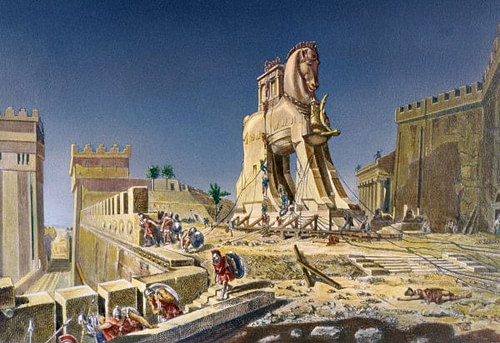
The Trojan Equus caballus
Troy Half-dozen was likewise partially destroyed, with testify of burn down and, intriguingly, statuary arrowheads, spear tips, and slingshots have been found embedded in the fortification walls, strongly suggesting some sort of conflict. The dates of these (c. 1250 BCE) and the site destruction correlate with Herodotus' dates for the Trojan War. It is extremely unlikely that homer'south ten year-conflict really occurred but the myth may well have been based on smaller, more repeated conflicts between the Mycenaeans and Hittites every bit they battled for control of lucrative trade routes in the Aegean.
The Mask & Tomb of Agamemnon
The so-chosen 'Decease mask of Agamemnon', which is a beaten gilded funeral mask from Grave Circumvolve A, at Mycenae dates to the mid-16th century BCE. The mask, one of 5 in fact, therefore, predates Agamemnon past 400 years merely nevertheless remains solid evidence of Homer'south description of Mycenae as 'rich in gold'. The attribution to Agamemnon was commencement suggested past Heinrich Schliemann who excavated both Troy and Mycenae in the 18th century CE. The mask was laid upon the face of the deceased and some scholars propose it is an early on endeavour at portraiture in European art. The mask is on permanent brandish at the National Archaeological Museum of Athens.
Only outside the acropolis of Mycenae is the celebrated tholos tomb, known as the Treasury of Atreus. It is a monumental circular edifice with a corbelled roof reaching a superlative of 13.5 yard and is fourteen.6 1000 in bore. It is approached by a long walled and unroofed corridor 36 m long and 6m broad. Lacking any written or pictorial show and dating from the 14th century BCE it is, once once more, too early to be connected with the mythical Agamemnon. Interestingly, cults of Agamemnon did arise in later centuries subsequently the Mycenaeans had long since disappeared, especially at Mycenae where his tomb was thought to lay but also at Chaeronea, Klazomenai, Tarentum, and in Laconian where it was also claimed lay the tomb of this swell mythical rex who had ruled Greece in the age of heroes.
This article has been reviewed for accuracy, reliability and adherence to academic standards prior to publication.
Source: https://www.worldhistory.org/Agamemnon_%28Person%29/
0 Response to "who was Agamemnon? What does he have to do with Odysseus?"
Post a Comment