what must happen for a fossil to form present day earth is in the period and epoch
Testify of Earth's Past
The planet Earth is approximately 4.five billion years quondam. Scientists employ the geological time calibration to describe World'southward history from its formation to the present twenty-four hours. The time span of 4.v billion years is divided into smaller segments or units called eons, eras, periods, epochs, and ages (Table 7.2). For example, the entire historic period of the earth is divided into four eons: the Hadean Eon, the Archean Eon, the Proterozoic Eon, and the Phanerozoic Eon. These iv eons are further subdivided into eras (Table 7.3).
| Unit | Time Span | Size |
|---|---|---|
| Eon | 0.five billion years or more (four eons total) | Largest |
| Era | several hundred million years (14 eras full) | |
| Flow | tens to several hundred of 1000000 years | |
| Epoch | tens of millions of years | |
| Age | millions of years | Smallest |

The earth'southward crust is equanimous of many layers of sediment piled on peak of each other over time. These horizontal layers are called rock strata and can be seen in canyons and rocky cliffs all over the world (Fig. 7.7). Geological fourth dimension units are based on obvious, sequential changes in the layers of Earth's rocks. The Law of Superposition in geology states that layers of sediment and stone are deposited over time in sequence with the oldest layers on the lesser and the youngest layers on top. For instance, a fossil constitute in a lowest stone stratum would likely be much older than fossils found in college strata.
Because the different geological time units are named for specific stone strata patterns and prominent features, they vary in time spans. For case, the Silurian and Ordovician are both geological periods in the Paleozoic Era, but the Silurian Menstruation spanned 443 million years while the Ordovician Period lasted only 45 million years.
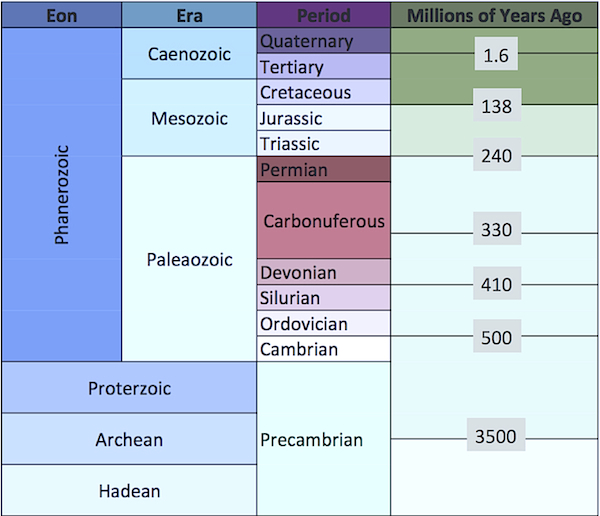 |
The Starting time of Globe's History
Scientists employ evidence both from World as well equally from other objects in our solar system to empathise the ancestry of Earth. The best data currently available has led scientists to judge that our solar system, including the earth, formed approximately 4.v billion years agone (bya). The world formed when meteorites collided and stuck to one another, gradually forming a planet. The oldest known Earth mineral has been dated to 4.4 billion years one-time. The oldest moon rock is approximately 4.5 billion years old. The moon is less geologically active than world, and thus has rocks that are older. The ages of several meteorites, which have the least geologic activity, accept been calculated to be between four.4 and 4.6 billion years former.
The First of Life on World
To understand the sea floor scientists examine both geological and biological history. I of the methods used past scientists to notice the change of Earth over time is the study of life in the fossil record. The fossil tape shows that life on Earth has grown increasingly complex over time. Studying this increase in complexity in the fossil record gives clues about the timing of the changes we tin can find in the sea floor. Although scientists do non know exactly how life first arose on Earth, at that place is evidence that primitive single-celled organisms chosen prokaryotes outset appeared between iii.8 and 3.5 billion years ago (bya). Modern-solar day bacteria are related to these ancient prokaryotic microbes. The appearance of similarly aged fossils of the same species on different continents helps scientists study how the World's tectonic plates have moved over time, including the ocean flooring.
For more detail on prokaryotes, run across What is Live?
For more detail on the origins of life on Globe, see Building Blocks of Life.


Around 3.4 bya, cyanobacteria became widespread on Earth, growing in dense microbial mats in shallow coastal waters. Cyanobacteria are microbial organisms that can produce their own food through photosynthesis, in a process roughly like to modern plants. The oldest fossilized layers of these blue-green alga—chosen stromatolites (fossilized microbial mats, Fig. 7.8)—appointment dorsum to iii.5 bya.
The Beginning of Complex Life on Earth
Prokaryotic bacteria were the merely life on Earth for at to the lowest degree two billion years—about one-half of the age of the planet (Fig. 7.ix). More complex organisms called eukaryotes first appeared in the fossil record around 2.1 to 1.8 bya. Eukaryotes are organisms that have cells containing a nucleus and other structures enclosed within membranes (Fig. vii.10). All living organisms other than bacteria are eukaryotes. Some eukaryotic species, such as protists, alive as single-celled organisms. All true multicellular life—organisms comprised of many different living cells—are eukaryotes. These include algae, plants, fungi, and animals.


The first multicellular eukaryotic life appeared in the fossil record betwixt 2 and 0.6 bya (600 1000000 years ago). Unmarried-celled organisms can live in shut colonies or even form filaments or microbial mats like cyanobacteria (Fig. 7.8). However, the first multicellular organisms could develop specialized tissues or groups of cells with specific properties and tasks. For instance, a found might have root tissue with cells very different from the cells in its leaf tissue. The arrival of multicellularity led to the relatively rapid evolution of new forms of life. The fossil record in World's layers bear witness how, over time, circuitous life has evolved.
The Cambrian Explosion and Extinction
The Cambrian explosion is the proper name of the upshot marking the rapid diversification of many new groups of multicellular organisms from a single common ancestor. The term "explosion" in this example does not refer to an asteroid impact, volcanic eruption, or trigger-happy earthquake, rather it refers to the sudden appearance of many new complex organisms in the fossil record. In geological terms, "rapid" and "sudden" can mean a few million years. The Cambrian explosion began around 542 million years ago and continued for some other 20 million years. This event marked a major turning betoken in the development of life on Globe, particularly for animals. Before the Cambrian explosion (known as "precambrian" fourth dimension), life on the planet more often than not consisted of single-celled microbes and some relatively simple, soft-bodied multicellular organisms. After the Cambrian explosion, many new types of circuitous multicellular organisms and most major groups of animals began to appear in the fossil tape (Fig. 7.eleven).
The time that followed the Cambrian explosion is divided into three geological eras: Paleozoic, Mesozoic, and Cenozoic.


The Paleozoic era spanned from 540 to 252 meg years ago (mya) and represents the beginning era of diverse, circuitous life on Earth. The name Paleozoic means "aboriginal life." During the early Paleozoic era, many new groups of marine invertebrates (animals without backbones) dominated the earth, although primitive vertebrates (animals with backbones) also began to appear. As the Cambrian explosion connected, near all of the major groups of modernistic animals evolved from shared mutual ancestors. The ancient globe bounding main brimmed with invertebrate animals such every bit sponges, corals, and venereal (Fig. 7.11 A) as well as the first vertebrate animals: fishes (Fig. 7.eleven B). The first animals to begin to colonize dry out land were probable arthropods (Fig. seven.eleven C). Arthropods are a group of invertebrate animals with jointed artillery and hard shells including venereal, shrimp, spiders, and insects. Past the cease of the Paleozoic era—almost 300 mya afterward the Cambrian explosion—arthropods, amphibians, and some archaic reptiles dominated the terrestrial surround (Fig. 7.xi D). The Paleozoic era came to a sudden end around 252 mya with the single largest extinction event in Earth's history.
The Permian-Triassic extinction event—also known equally "the great dying"—saw the sudden disappearance of 80 to 96 per centum of all marine species and almost 70 percent of all country vertebrate species around 252 mya. The crusade of this extinction event remains unresolved, however scientists have proposed several possible scenarios including asteroid impacts and catastrophic volcanic events. This extinction event is one of many throughout the history of life on Globe.
The Age of Reptiles
The Mesozoic era or "age of reptiles" began 252 mya at the finish of the Paleozoic era and continued until 66 mya. The land was covered with non-flowering gymnosperm plants, the ancestors of modernistic-day conifer trees (commonly known as evergreen or pino trees). The tree species Ginkgo biloba evolved during the Mesozoic era and survives to this day (Fig. seven.12 A). Information technology was also during this time that scaly-skinned reptiles replaced amphibians as the dominant vertebrate animals on land. Reptiles are a large and diverse group of vertebrate animals. Well-nigh of the reptile groups that lived in the Mesozoic era are extinct today. The all-time-known extinct reptile grouping is the dinosaurs. Dinosaurs represent a diverse group of reptiles with many different sizes and shapes (Fig. seven.12 A-C). Dinosaurs and other reptile groups such equally flying pterosaurs (Fig. vii.12 B) and swimming ichthyosaurs (Fig vii.12 C) were the dominant vertebrate animals on Globe for almost 200 meg years during the Mesozoic era. Despite depictions in popular Hollywood films, Tyrannosaurus king would never have dined on a Stegosaurus or Brachiosaurus (Fig. 7.12 D). Those dinosaur species were extinct long before the evolution of T. male monarch.


The Mesozoic era and the long reign of the dinosaurs ended around 66 mya with another dramatic mass extinction in which most of the dinosaurs were wiped out. The extinction of the dominant dinosaurs cleared the way for a previously obscure group to flourish: the mammals.
The Age of Mammals
The Cenozoic era has been called the "historic period of mammals", because it was during this era that mammals became the dominant vertebrate animals on land. This geological era spans from 66 mya to the present day. The homo species is an instance of a Cenozoic era mammal species.
Although the ancestors of early mammals commencement evolved in the late Paleozoic era and coexisted with dinosaurs during the Mesozoic era, this group did non flourish until the Cenozoic era that began 66 mya. During the Cenozoic era, mammals became much more than diverse, from minor shrews, rodents, and bats to large bears, whales, and apes (Fig. 7.13).


During the late Cenozoic era, around two 1000000 years ago, the first early homo species evolved from an ape ancestral species. Anatomically mod humans (Human being sapiens) first appeared in the fossil tape around 200,000 years ago. All of known human history falls within the previous ten,000 years—a very short fourth dimension compared to the residuum of the geological timescale (Tabular array seven.two).
The globe has changed a great deal over its long iv.five billion twelvemonth history. It has gone from a molten brawl of elements to a layered rocky planet. Following the emergence of plants, an atmosphere rich in oxygen, supporting a lush green earth, has replaced World's early atmosphere of marsh gas and carbon dioxide. The history of life on Earth, from microscopic leaner to enormous whales, reflects the many changes the planet has undergone.
Activity: Timeline of Earth
Develop a model to illustrate the timeline of Earth's geological and evolutionary history.
Mass Extinctions
The fossil record provides strong and abundant prove of several mass extinctions of throughout the history of the planet. These extinction events indicate sudden, catastrophic changes on Earth. For example, the boundary between Paleozoic and Mesozoic eras (between Permian and Triassic periods) is marked by the extinction of over 90 per centum of all species living at the time. This Permian-Triassic extinction event is the single largest loss of biodiversity in Earth's history. Similarly, the cease of the age of reptiles and dinosaurs was marked by the Cretaceous-Paleogene extinction event around 66 mya.
Scientists accept long sought evidence of the causes of these mass extinctions. Information technology is hypothesized that an asteroid impacting Earth caused the decline of the dinosaurs during the Cretaceous-Paleogene extinction. This hypothesis is supported by evidence from ancient craters, rocks enriched with rare minerals constitute only in meteorites, and stone formations indicative of major touch. Other evidence shows that major volcanic eruptions, glaciers, or the motion of landmasses caused other mass extinctions.
Source: https://manoa.hawaii.edu/exploringourfluidearth/node/1341
0 Response to "what must happen for a fossil to form present day earth is in the period and epoch"
Post a Comment