How to Read Dna Results With Just Father and Child
The modern-day paternity exam compares a baby'southward DNA profile to the potential father'southward. How did we ever manage it before genetics?
Occasionally, situations arise in which people crave concrete, scientific bear witness of parentage, whether information technology exist their ain or that of someone else. In most instances, maternity is easy to decide. Before surrogate motherhood became possible, the woman who gave birth to a child was obviously that child'due south gestational, genetic, and legal mother, and this continues to be truthful in the vast majority of cases today.
Unfortunately, questions of paternity aren't so piece of cake to answer. In order to make a determination of fatherhood, scientists about ever piece of work backwards--from the kid to the potential parent--to define the actual nature of the relationship. In the past, this typically involved identifying specific phenotypes (in detail, specific blood types) in the child and using this data to either "rule in" or "dominion out" possible fathers. However, this organisation presented a number of bug, not the to the lowest degree of which was that it often yielded inconclusive results. Thus, since the 1990s, the more mutual approach has been to consider the presence of particular genotypic markers when attempting to found fatherhood (and, in a scattering of cases, motherhood).
Using Blood-Typing in Paternity Tests
The procedure of Deoxyribonucleic acid fingerprinting was developed by Alec Jeffreys in 1984, and information technology beginning became bachelor for paternity testing in 1988. Before this sort of Deoxyribonucleic acid assay was available, blood types were the nigh mutual gene considered in human paternity testing. Blood groups are a popular instance of Mendelian genetics at work. After all, in that location are numerous human blood groups with multiple alleles, and these alleles exhibit a range of dominance patterns.
Today, the best-known claret-typing system is ABO typing, which involves the presence of antigens on red claret cells that are encoded past the ABO locus on man chromosome 9. In the ABO organisation, the A allele and the B allele are codominant, and the O allele is recessive. Thus, if a person's ABO blood type is O, he or she has ii O alleles. If, however, a person'south blood blazon is A, he or she has either ii A alleles or one A allele and one O allele. Similarly, if a person has type B blood, this indicates the presence of either ii B alleles or one B allele and one O allele. Finally, some people have type AB blood, which means they inherited both an A allele and a B allele.
In cases of questioned paternity, ABO claret-typing can be used to exclude a man from being a child's begetter. For case, a man who has type AB blood could non father a kid with type O blood, because he would laissez passer on either the A or the B allele to all of his offspring. Despite their usefulness in this regard, ABO claret groups cannot exist used to ostend whether a man is indeed a kid'southward father. Because of this and several other factors, it took the legal system some fourth dimension to trust blood-typing. For example, in a famous case in 1943, the starlet Joan Barry accused histrion Charlie Chaplin of fathering her kid. Although blood tests definitively excluded Chaplin as the father, the court did not permit this evidence to exist admitted, and Chaplin was ordered to pay child support to Barry. The Barry/Chaplin instance did spur the passage of new laws, withal, thus launching a new era in forensic evidence.
Over time, the use of additional blood antigens, such equally those associated with the MN and Rh systems, refined the utilise of blood-typing for both paternity and forensics. Still, such claret groups were only about 40% effective in ruling out a man as a child's male parent. Then, in the 1970s, testing for human being leukocyte antigens (HLAs) added a distinguishing characteristic that fabricated information technology possible to dominion out men equally fathers with 80% effectiveness. The genes responsible for the HLA organization are involved in antigen presentation to T cells. The HLA system is highly polymorphic, with more than three,200 different alleles identified and so far (Robinson et al., 2003; Williams, 2001). Although this vast number of alleles causes headaches for jail cell and organ transplants, the multiplicity of genotypes the HLA system provides—in the tens of millions—makes it ideal for consideration in identity and paternity testing.
DNA Markers and Electrophoresis
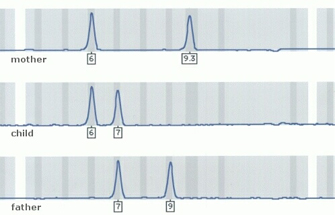
© 2008 Gendia All rights reserved. 
In the 1970s and 1980s, electrophoresis of various biochemical markers became widely bachelor. With this process, proteins from a person's claret or other tissue were placed onto a gel, such as tater starch, agarose, or polyacrylamide. An electric current was then run through the gel, and different forms or isozymes of the proteins were separated by their electrical charge and/or size. Differences in isozymes relate to differences in the alleles that code for these proteins. Thus, the presence of certain identical isozymes in samples from both a kid and his or her potential father could be used to reveal the existence of a genetic human relationship betwixt the two individuals (Figure one). In fact, past 1974, Chakraborty et al. suggested that genetic testing via electrophoresis had advanced such that this method might be used to confirm paternity rather than but exclude a human being as a child's father.
Today, with the advent of numerous Dna sequencing, amplification, and testing techniques, paternity testing has evolved even further than predicted. Indeed, nowadays-day genetic testing has an accuracy charge per unit of up to 99.99% (i.east., 9,999 out of 10,000). Of course, the verbal level of accuracy depends on the number and quality of the genetic markers being considered. (Here, it is important to emphasize that scientists consider only specific marking alleles, rather than unabridged genomes, when conducting paternity testing. Full genome analysis would add a neat deal of time and expense to the procedure without significantly improving the accurateness of the results.) Thus, Deoxyribonucleic acid-based forms of paternity testing have all but taken over before methods. In addition, college throughput, better sensitivity, and automation have allowed Dna testing to be performed on e'er-smaller and sometimes degraded DNA samples with greater speed and excellent accurateness.
The Utility of Paternity Testing
Interestingly, improvements in paternity testing over the by several decades accept not only led to an increase in the accuracy of test results, simply likewise to expanded application of various testing methods. For example, every bit DNA technology has gotten more precise, information technology has become possible to determine paternity using Deoxyribonucleic acid from grandparents, cousins, or even saliva left on a discarded java cup. Such Deoxyribonucleic acid testing is clearly an important part of criminal investigations, including forensic assay, but it is also useful in civil courts when the paternity of a kid is in question. The widespread availability of paternity tests on the web and in neighborhood drugstores is also indicative of a civil need for this engineering. Still, it is of import to note that such direct-to-consumer (DTC) tests will not stand up in court because there is no way to prove whose samples were analyzed. Hence, DTC testing is most oft used to assist in making a decision to initiate litigation or to merely provide peace of mind in matters of questionable paternity.
In broader applications, advances in paternity testing mean that people who were adopted now have more direct means to confirm their biological identity or to find their birth parents. In addition, parentage testing is ofttimes an essential tool in proving clearing condition in cases of family reunification.
Summary
For years, questions of paternity presented a significant challenge to scientists and potential parents akin. During the first half of the twentieth century, researchers ofttimes turned to people'southward ABO phenotypes when such bug arose; however, ABO blood group information could simply be used to exclude potential fathers, rather than confirm the presence of a parental human relationship. Consideration of additional blood markers, such as Rh antigens, MN antigens, and HLAs, profoundly increased the effectiveness of paternity testing over the next few decades, but information technology still left significant room for error. Thus, with the dawn of Deoxyribonucleic acid analysis and sequencing techniques in the 1980s and 1990s, scientists increasingly began to look at people's genomes when questions of fatherhood arose. This approach proved exceedingly useful; in fact, current marker-based methods of analysis yield test results that are both 99.99% accurate and applicable in a diversity of settings. With the ongoing advancement of DNA sequencing and analytical technologies, we will no dubiety continue to run across an increment in the utility of these tests, as well every bit in the availability of detailed genetic services to the general public.
References and Recommended Reading
Bhende, Y. M., et al. A "new" claret group character related to the ABO arrangement. Lancet 6714, 903–904 (1952)
Carey, Fifty., & Mitnik, 50. Trends in DNA forensic analysis. Electrophoresis 23, 1386–1397 (2002)
Chakraborty, R., et al. Exclusion of paternity: The current land of the art. American Journal of Man Genetics 26, 477–488 (1974)
Jeffreys, A. J., et al. Individual-specific "fingerprints" of homo Dna. Nature 316, 76–79 (1985) doi:10.1038/316076a0 (link to commodity)
Robinson, J., et al. IMGT/HLA and IMGT/MHC: Sequence databases for the written report of the major histocompatibility complex. Nucleic Acids Inquiry 31, 311–314 (2003)
Williams, T. M. Human leukocyte antigen gene polymorphism and the histocompatibility laboratory. Journal of Molecular Diagnostics three, 98–104 (2001)
Source: http://www.nature.com/scitable/topicpage/paternity-testing-blood-types-and-dna-374
0 Response to "How to Read Dna Results With Just Father and Child"
Post a Comment